Midnight Children
Midnight's ChildrenThe Midnight Children are the 1,001 children born in India between midnight and one o’clock on August 15, 1947, each endowed with an unusual gift or faculty. Saleem Sinai’s awareness of them transforms an isolated childhood power into a national-scale community: by gathering their minds into the Midnight Children’s Conference, he gives scattered individuals a shared identity, while the novel makes their diversity and eventual separation a measure of the promises and fractures of independent India.
Birth and defining condition
The cohort’s defining hour coincides with the birth of sovereign India. Saleem calls attention to the number of births—1,001—while setting it against the ordinary arithmetic of population: births in the region exceeded deaths by about 687 an hour. What distinguishes these children is not their number alone but the miraculous qualities each acquires, whether through biology, a supernatural power of the moment, or coincidence. Their arrival gives historical time an uncanny charge, as though the country’s moment of independence had seeded a future unlike the past.
The gift is bounded by the new country’s frontiers. Saleem can speak only of the children within his own perceptual reach, a field limited both by geography and by the borders dividing Punjab and Bengal. He does not know whether a corresponding miracle occurred in Pakistan. The children thus embody national independence while also inheriting its limits: their collective begins as a phenomenon whose reach is shaped by the partitioned map.
Powers and unequal fates
By 1957, 581 children survive, most of them nearing their tenth birthdays and unaware of one another. Their gifts do not make them uniformly fortunate. Some children are untouched by knowledge of their shared birth-hour; others suffer because of their abilities or the reactions those abilities provoke. A pair of twin sisters in Baud, for example, inspire obsessive love in the men who see them, with consequences that include self-mutilation and suicide. Sundari’s extraordinary beauty blinds her mother and nearby women at her birth, and later a great-aunt slashes her face nine times; the disfigurement then becomes the basis for the alms she receives.
Saleem’s account ranges across abilities that turn the body into a passage, instrument, or disturbance. A boy from Kerala can enter mirrors and emerge through reflective surfaces elsewhere; a Goan girl can multiply fish; a boy from the Nilgiri Hills becomes a werewolf; and a child from the Vindhya watershed can change size. A child from Kashmir can alter sex by immersing in water. Elsewhere, a youth can divine water, a girl’s sharp words can wound physically, a boy can eat metal, and a girl can grow prize aubergines in the Thar Desert. The variety makes the cohort less a single kind of miracle than a crowded field of incompatible possibilities.
Their survival and gifts are not guaranteed. Some have died, while others have lost the qualities bestowed at birth. The surviving number therefore measures attrition as well as community: the miraculous cohort is already diminished before Saleem discovers it, and its powers are not simply possessions that each child can count on keeping.
Saleem’s discovery and the making of a community
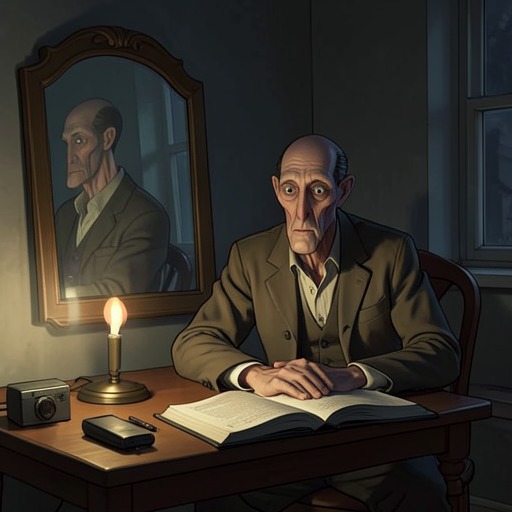
Saleem’s own gift emerges through an intensely private bodily episode. Nearly nine years old, he hides inside a washing-chest and overhears his mother, Amina Sinai, speak and act in a way that discloses the name Nadir Khan and the memory of an earlier intimacy. A pajama cord rises into Saleem’s nostril; his involuntary, world-altering sniff drives fluid into his sinuses until something bursts and an electrical sensation begins. The origin of his telepathy is thus bound not to public ceremony but to concealed family knowledge, bodily discomfort, and a child’s accidental access to adult secrets.
The new ability initially has a small, compromised use. Saleem listens in on teachers and classmates to improve his schoolwork, taking answers from their thoughts while altering them enough to avoid suspicion. Looking back, he judges this choice harshly: rather than using his capacity for the needs of a poor, underdeveloped country, he spends it on voyeurism and cheating. He links the choice to childhood confusion between morality—doing what is right—and popularity—doing what earns approval. Afraid of parental rejection, he conceals the gift; hungry for parental praise, he turns it to school advantage. The powers of the Midnight Children do not automatically produce public purpose or heroic conduct.
A bicycle accident jolts Saleem into awareness of the other children. At first he collects their secrets one by one, fascinated by their separate and brighter reality, while remaining more attentive to extraordinary gifts than to the children’s ordinary selves. He gradually recognizes the pattern their birth-time supplies. On his tenth birthday, after Evie Burns and other children occupy the clocktower that had sheltered him, he learns that 581 other children are celebrating their birthdays too. The discovery gives an explanation to his original hour of birth and converts exclusion from one group into the occasion for forming another.
The Midnight Children’s Conference
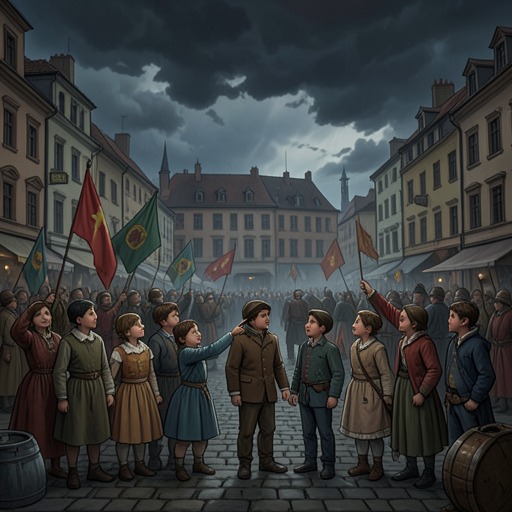
Saleem answers that birthday revelation by creating the Midnight Children’s Conference, a gang spread across the country with its headquarters behind his eyebrows. He takes the initials M.C.C. from the Metro Cub Club, which also shares them with the touring English cricket team, and transfers them to his new assembly. The borrowed initials make the conference at once a child’s improvised institution and a national network imagined through familiar names and games.
The conference is more than a list of supernatural talents. Its members are linked by a shared time of birth and brought within Saleem’s mental field, so that dispersed children can become, at least in imagination, a collective. Yet the number of those available to him is already 581, not the original 1,001; their powers differ sharply, and most have grown up ignorant of their fellows. The conference’s unity is therefore achieved against distance, loss, and uneven knowledge rather than guaranteed by the birth-hour alone.
Nation, memory, and historical fracture
Saleem presents the children as a possibility born with the country: history seems to sow seeds of a future that might genuinely differ from what came before. But the narrative never treats their miraculous gifts as a simple promise of national improvement. Saleem admits that he misuses his own ability, and the children’s powers can isolate, injure, or endanger them. The cohort’s extraordinary capacities coexist with poverty and ordinary vulnerability; their difference does not release them from the circumstances around them.
The image of collective possibility also carries a tension between inward unity and outward division. The children can be gathered in Saleem’s mind, but their lives remain geographically dispersed and politically bounded; the borders of Punjab and Bengal constrain his knowledge, while the wider community mostly does not know it exists. When Saleem later recalls childhood humiliations and bodily injuries, the Midnight Children appear within a life shaped by exile, loss, and unfairness rather than in a story of uninterrupted wonder. His retrospective account, full of fragments and gaps, makes the cohort’s history dependent on memory and narration as well as on supernatural connection.
The children consequently stand both for the promise of a newly independent country and for the fragility of any imagined national togetherness. Their common birth moment gives them a powerful correspondence, but not a common fate: 1,001 births become 581 surviving children, many unaware of one another, with gifts that can bless, burden, or disappear. The conference is Saleem’s attempt to turn that uneven inheritance into a shared story.